 Track an order
 Buy It Again
 Favourites
 Manage account
 Rewards
 Subscriptions
 Find a store
 Help centre


Find your new favourite way to enjoy Manuka honey, with a drizzle of insight from a nutritionist and the truth about the science
Summary
1What’s Manuka honey?
Manuka honey is made by bees that collect nectar from the Manuka bush, native to New Zealand. Unlike regular honey, Manuka contains higher levels of..
2How much Manuka honey can I have a day?
Our nutritionist recommends sticking to around one to two tablespoons per day – enough to enjoy the flavour while still being mindful of the natural..
3How to use Manuka honey
There are so many ways to use this honey. Why don’t you try swirling it into hot water or tea, add a drizzle to breakfast bowls or yoghurt or eat it..
Manuka honey has been buzzing around lifestyle circles for years – but is it all hype, or is there real science behind its popularity? We asked nutritionist Holly Pullen to help separate fact from folklore and gathered up some of our favourite ways to enjoy this intriguing honey.
According to Holly, “Manuka honey contains natural compounds that researchers are looking into it – but it’s best thought of as a soothing addition, not a medicine.”1 With her expert insight, here’s how to get the most from this delicious and distinctive product.
What’s Manuka honey?
Manuka honey is made by bees that collect nectar from the Manuka bush, native to New Zealand. Unlike regular honey, Manuka contains higher levels of methylglyoxal (MGO) and dihydroxyacetone (DHA), which is exactly what researchers are reviewing to understand if there’s any antibacterial properties associated.2 Holly reminds us: “There’s promise, but more research is needed – Manuka honey is best used as a tasty, soothing addition.”1
“Manuka’s best enjoyed for its taste and tradition – not as a medicine”
The strength of Manuka honey is typically measured by its MGO score – the higher the number, the greater the concentration of MGO.
How much Manuka honey can I have a day?
There’s no hard‑and‑fast rule, but Holly recommends sticking to around one to two tablespoons per day.3 That’s enough to enjoy the flavour while still being mindful of the natural sugar content. “Even though it’s natural, it’s still honey – so moderation is key,” she says. That could look like one teaspoon in your tea and another in a recipe or over fruit – and you’re good for the day.
“Let your tea cool slightly before stirring in the honey as it keeps the enzymes intact”
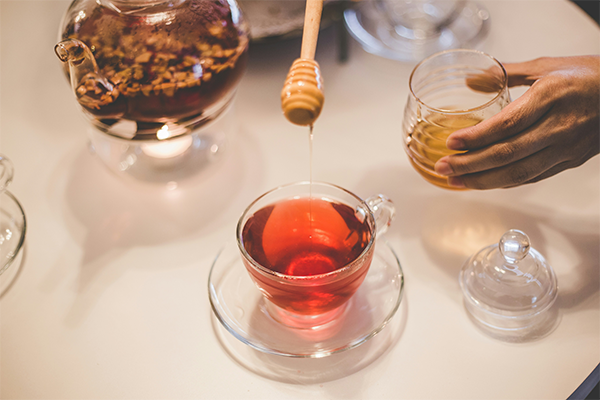
How to use Manuka honey
From morning porridge to soothing evening drinks, here are some simple ways to enjoy it.
Swirl into hot water or tea
Manuka honey has long been used as an addition to warm drinks – particularly to help with soothing. But be careful: don’t add it to boiling water, as high heat can destroy some of its natural compounds.4
“Let your tea cool slightly before stirring in the honey – around 40 °C is ideal,” advises Holly. “It keeps the enzymes intact and gives you the full flavour.” Try it with lemon, ginger or your favourite herbal blend for a soothing ritual with a pleasant taste.
Add a drizzle to breakfast bowls or yoghurt
Whether it’s porridge, Greek yoghurt or a stack of pancakes, Manuka honey brings a rich, floral sweetness that levels up your breakfast. Its thick texture means it holds its own, both in flavour and presentation. Mix with nuts, fruit or seeds for a satisfying balance of taste and texture – or try it stirred through our Masala chai porridge for a warming, spiced start to your day.
Make a Manuka honey dressing
Manuka honey isn’t just for tea and toast – it makes a great addition to homemade dressings too. Combine roughly two parts olive oil with one part lemon juice or apple cider vinegar, then stir in a spoonful of Manuka honey and a little Dijon mustard to balance the sweetness. Add salt, pepper and some fresh herbs if you have them, then drizzle generously over your greens.
Use it as a natural sweetener in baking or smoothies
Manuka honey can replace sugar in baking, though it’s best used in recipes where the flavour and colour are welcome. Its natural sugars, mean it can darken quickly in the oven – so consider reducing the oven temperature slightly. In smoothies, add it at the end and you may need less than you’d use with ordinary honey due to its distinct taste. It also works well in chilled desserts – we use it to sweeten our pistachio and chocolate froyo for a creamy, naturally sweet finish.
Our favourite Manuka honeys
From premium high MGO to added extras, here are the Manuka honeys we keep coming back to – whether you’re stirring into oats or enjoying straight off the spoon...
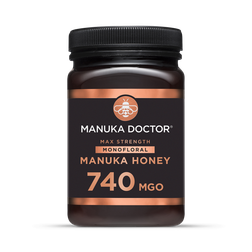
This Manuka honey is 100% pure New Zealand goodness – straight from the hive, just as nature intended. Containing 740 MGO – a high score that indicates strong natural activity – it’s ideal for anyone looking for a high-quality honey.
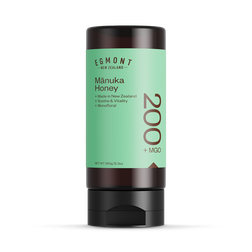
This monofloral Manuka comes from bees gathering nectar under the shadow of New Zealand’s Mount Taranaki. With an MGO of 200+, this honey offers genuine Manuka flavour sourced from remote New Zealand landscapes. Monofloral Manuka tends to have higher levels of MGO compared to multifloral varieties.
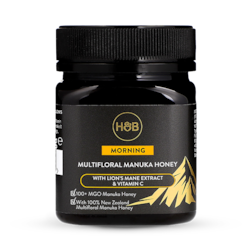
H&B’s Morning Ritual Manuka honey 100+ MGO combines natural multifloral Manuka with lion’s mane extract and vitamin C – designed as a thoughtful addition to your morning routine. With a 100+ MGO rating, it’s a gentle way to start the day with extra natural ingredients.
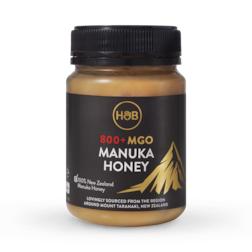
H&B’s MGO 800+ Manuka has a notably high concentration of MGO, sourced straight from New Zealand’s landscapes. Its 800+ MGO rating reflects a strong level of natural activity, while still being suitable to enjoy every day.
The final say
From dressings to desserts, Manuka honey is a delicious way to step-up your daily routine. Ready to lift the lid on all things Manuka? Jump into our ultimate guide to Manuka honey or browse our complete round-up of the best Manuka honey products.
Disclaimer – This article provides informational advice and is not a substitute for medical care. Working with experts for accuracy, we take great care to ensure the information is up-to-date and relevant. However, you should always consult your GP or healthcare professional before using supplements or alternative products, particularly if you have medical conditions or are under supervision.
1. Johnston M, McBride M, Dahiya D, Owusu-Apenten R, Singh Nigam P. Antibacterial activity of manuka honey and its components: An overview. AIMS Microbiology [Internet]. 2018 Nov 27;4(4):655–64. Available from: https://pmc.ncbi.nlm.nih.gov/articles/PMC6613335/
2. Adams CJ, Manley-Harris M, Molan PC. The origin of methylglyoxal in New Zealand Manuka (Leptospermum scoparium) honey. Carbohydr Res. 2009;344(7):1050–1053.
3. Nolan VC, Harrison J, Wright JEE, Cox JAG. Clinical Significance of Manuka and Medical-Grade Honey for Antibiotic-Resistant Infections: A Systematic Review. Antibiotics [Internet]. 2020 Oct 31;9(11):766. Available from: https://www.ncbi.nlm.nih.gov/pmc/articles/PMC7693943/
4. Shadkam MN, Mozaffari-Khosravi H, Mozayan MR. A comparison of the effect of honey, dextromethorphan, and diphenhydramine on nightly cough and sleep quality in children and their parents. Journal of Alternative and Complementary Medicine (New York, NY) [Internet]. 2010 Jul 1;16(7):787–93. Available from: https://pubmed.ncbi.nlm.nih.gov/20618098/
Related to this article


