 Track an order
 Buy It Again
 Favourites
 Manage account
 Rewards
 Subscriptions
 Find a store
 Help centre
What time is it? How to adjust when the clocks change

Written byJodi M Johnson

Reviewed byHeeral Tomlinson

Out of sync when the clocks change? Don’t lose sleep over it... Let’s look at why it messes with your routine and how you can adjust like a pro
Summary
1When do the clocks go forward?
In the UK, the clocks go forward by one hour at 1am on the last Sunday in March.
2Why do the clocks change?
William Willett proposed that the clocks change in summer and winter to allow more daylight.
3How does the clock change impact our mood?
Your circadian rhythm can get a shake-up. This sudden time shift may leave you feeling a little off balance.
So, the clocks went forward and now you can’t sleep. You’re not alone. When the clocks spring forward, we lose an hour of precious sleep – but gain lighter, brighter evenings in return. But does this small shift in time have a bigger impact on us than we think?
As the seasons change, so do our routines – leaving many of us wondering how just one hour can throw us off balance. Is it the nudge we need for brighter mornings and longer days or does it leave us feeling a little more sluggish than usual? Let’s pull back the covers on this phenomenon and explore how the time change really affects our minds and bodies.
When do the clocks go forward?
In the UK, the clocks go forward by one hour at 1am on the last Sunday in March. This year, that falls on the 30th.1 When the clocks go forward, the UK moves from Greenwich Mean Time (GMT) to British Summer Time (BST). 1
Why do the clocks change?
History lesson incoming. In the early 1900s, a builder called William Willett proposed that the clocks change in summer and winter to allow more daylight.2 By doing this, UK citizens would have one more hour of light in the darker months.
Willett’s campaign wasn’t too successful during his lifetime, but after the First World War, Germany adopted this idea. The UK followed in 1916, with the government introducing British Summer Time and the clocks have changed twice a year ever since.
How does the clock change impact our mood?
When the clocks change for Daylight Saving Time (DST) and GMT, your circadian rhythm – the natural body clock that runs on a 24-hour cycle – can get a shake-up. This sudden time shift may mess with your sleep, mood and productivity, leaving you feeling a little off balance.3,4 Your circadian rhythm is like an internal guide, syncing with light and dark to regulate everything from mental sharpness to physical health.3 It’s not just for humans – animals, plants and even microbes follow their own internal clocks too.5
So, when that hour shifts, your body might struggle to adjust and it could leave you feeling sluggish. But don’t worry, we’ve got tips to help you get back in sync and fall back with ease:
- practice good sleep hygiene: this includes habits and your environment, as they can all influence sleep for better or worse. Try keeping your bedroom cool, quiet and dark and avoid screens for at least 30 minutes before bed
- create a consistent sleep routine: going to bed and waking up at the same time every day helps regulate your body’s internal clock. This helps promote better quality sleep and makes falling asleep and waking up easier 6
- gradually alter your bedtime routine: if you need to shift your sleep schedule, do so gradually – by about 15 to 30 minutes each night. A slow, steady transition allows your body to adapt 7
- limit light exposure in the evening: longer, lighter evenings can confuse your body’s natural sleep signals by making it feel like it’s still daytime.8 To help your body wind down, keep your bedroom as dark as possible – use blackout curtains or blinds and dim indoor lighting in the hours before bed. Creating a darker environment can support better sleep quality even when it stays light outside later into the evening. 9
- nap in moderation: short naps (20-30 minutes) earlier in the day are ideal for supporting energy without affecting nighttime sleep. Studies suggest that longer naps or naps taken too close to bedtime may lead to you feeling groggier and disrupt your nighttime rest 10
- avoid caffeine too close to bedtime: that goes for dark chocolate too. Caffeine can delay you getting to sleep and in some people, it can take up to six hours for the effects of caffeine to wear off 11
Our top products for your bedtime routine
If you're still tossing and turning, don’t worry – we've got a dreamy selection of products to give you a hand.
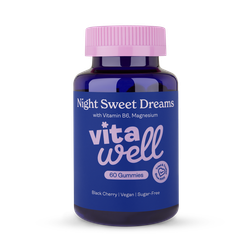
In an ideal world, we’d all have an elaborate sleep ritual: a warm bath; a nightly meditation; feather-soft fresh bedding. While these gummies can’t replicate that, they can be a good addition to your evening, with magnesium to help reduce tiredness and fatigue.12 These one-a-day gummies are formulated with vitamin B6, which contributes to normal psychological function and the regulation of hormonal activity.13,14 Botanical extracts of lavender, chamomile and lemon balm make this a combo designed for the ultimate sleepytime routine. Oh, and the black cherry flavour feels like a grown-up take on your standard gummy.
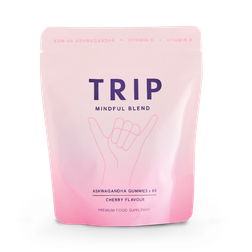
You might know TRIP for their CBD-infused drinks, but big news: they’ve branched out into gummies too. These ‘mindful blend’ chews swap CBD for ashwagandha, an adaptogenic herb. The science on ashwagandha’s still emerging but we can shout about the vitamins in these gummies: B6 for normal nervous system function, B12 for normal psychological function and vitamin D to support normal immune health.15,16,17 In TRIP’s words, take two cherry-flavoured gummies daily, or on days when life gets loud.
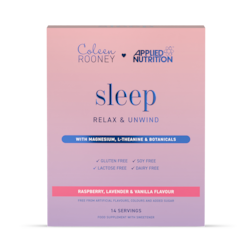
Not one for a hot cocoa? Coleen Rooney’s paired with Applied Nutrition for a bedtime drink that’s fruity and formulated to help you relax. Raspberry, vanilla and lavender make for a super-elegant flavour combo. But it’s not all about the fancy feel: each sachet contains a blend of ashwagandha, passionflower and valerian.
You’ll also benefit from 100% of your daily B12 (important for normal nervous system and muscle function), as well as 5mg zinc for normal cognitive function and inulin fibre.18,19,20 The travel-sized sachets are perfect for taking on the go, so it’s by your side during nights away. Mix with hot or cold water and drink 30 minutes before you hit the hay.
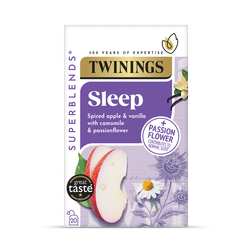
Unwind and cosy up with the ultimate bedtime brew. This tea combines the sweet, spiced warmth of apple and vanilla, with chamomile and passionflower. Smooth and oh-so-warming, this delightful herbal infusion is the perfect companion to your routine. Simply pop the teabag in hot water and let the infusions do the rest. Sip and relax...
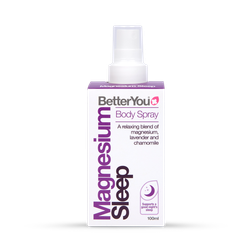
This spray blends magnesium with the calming scents of chamomile, bergamot and clary sage to help soothe the senses and melt away the day. Perfect for unwinding, it works wonders on your senses and gives your body that relaxing effect. We suggest spraying generously onto your skin and massaging in – even better after a warm shower or just before you get in bed. Sweet dreams await.
Sleep FAQs
Lighter evenings can make it a bit harder for some people to fall asleep. Light plays a key role in regulating your body’s internal clock, which controls when you feel awake and when you start to feel sleepy.21 When you’re exposed to light in the evening, your brain may delay releasing melatonin, the hormone that helps your body prepare for sleep. This can mean the extra light later in the day can make your body think it’s still daytime.21 Keeping your environment dim in the evening can help signal to your body that it’s time to wind down and get ready for sleep.21
Let’s say bedtime is usually 8pm but after the clocks change that’s effectively 7pm. You have two options: adjust gradually or switch immediately. For a gradual change, start with a 9pm bedtime (still technically 8pm) and move it earlier by 10–15 minutes each night. Or go straight to the new 8pm bedtime; there may be some complaints and they might wake an hour earlier at first, but good sleep habits like a dark room can help them settle.
Lighter evenings can make it harder to fall asleep, so one simple step is blocking out excess light. A soft eye mask like Panda London 100% Bamboo Eye Mask can help create a darker sleep environment and signal to your brain that it’s time to rest.
The final say
Feeling a bit more prepared for when the clocks change? With a newly adjusted morning or night-time routine – and with the help of our recommended products – you’ll be able to adapt round the clock. For a little extra help, check out 12 simple habits to add to your evening routine. It can also help to wind down with calming habits, like with one of our favourite teas to enjoy in the evening or gentle sleep support in the form of sleep gummies. If you really feel out of sync due to these time adjustments, or experience low mood as a result, speak to your GP as they can advise on what's best for you.
Disclaimer – This article provides informational advice and is not a substitute for medical care. Curated by experts for accuracy, we take great care to ensure the information is up-to-date and relevant. However, you should always consult your GP or healthcare professional before using supplements or alternative products, particularly if you have medical conditions or are under supervision.
1. Government Digital Service. When do the clocks change? [Internet]. GOV.UK. 2016. Available from: https://www.gov.uk/when-do-the-clocks-change
2. Britannica. Daylight Saving Time [Internet]. Britannica [cited 2025 Sep 22]. Available from: https://www.britannica.com/topic/Daylight-Saving-Time#ref91653
3. Rishi MA, Ahmed O, Barrantes Perez JH, Berneking M, Dombrowsky J, Flynn-Evans EE, et al. Daylight saving time: an American Academy of Sleep Medicine position statement. Journal of Clinical Sleep Medicine. 2020 Aug 26;16(10).
4. MONK TH, APLIN LC. Spring and Autumn daylight saving time changes: Studies of adjustment in sleep timings, mood, and efficiency. Ergonomics. 1980 Feb;23(2):167–78.
5. National Institute of General Medical Sciences. Circadian Rhythms [Internet]. National Institute of General Medical Sciences. 2022. Available from: https://nigms.nih.gov/education/fact-sheets/Pages/Circadian-Rhythms.aspx
6. Bumgarner JR, Nelson RJ. Light at Night and Disrupted Circadian Rhythms Alter Physiology and Behavior. Integrative and Comparative Biology. 2021 Mar 31;
7. Pacheco D. Daylight Saving Time - How Time Change Affects Sleep [Internet]. Sleep Foundation. 2020. Available from: https://www.sleepfoundation.org/circadian-rhythm/daylight-saving-time
8. Gooley JJ, Chamberlain K, Smith KA, Khalsa SBS, Rajaratnam SMW, Van Reen E, et al. Exposure to room light before bedtime suppresses melatonin onset and shortens melatonin duration in humans. The Journal of Clinical Endocrinology & Metabolism. 2011 Mar 1;96(3):E463–72/
9. Circadian Rhythm [Internet]. Sleep Foundation. 2020. Available from: https://www.sleepfoundation.org/circadian-rhythm#link
10. Mantua J, Spencer RMC. Exploring the nap paradox: are mid-day sleep bouts a friend or foe? Sleep Medicine [Internet]. 2017 Sep;37:88–97. Available from: https://www.ncbi.nlm.nih.gov/pmc/articles/PMC5598771/
11. Drake C, Roehrs T, Shambroom J, Roth T. Caffeine Effects on Sleep Taken 0, 3, or 6 Hours before Going to Bed. Journal of Clinical Sleep Medicine [Internet]. 2013 Nov 15;09(11). Available from: https://jcsm.aasm.org/doi/10.5664/jcsm.3170
12. European Commission. Characteristics [Internet]. European Commission [cited 2025 Sep 22]. Available from: https://ec.europa.eu/food/food-feed-portal/screen/health-claims/eu-register/details/POL-HC-6401
13. European Commission. Characteristics [Internet]. European Commission [cited 2025 Sep 22]. Available from: https://ec.europa.eu/food/food-feed-portal/screen/health-claims/eu-register/details/POL-HC-6499
14. European Commission. Characteristics [Internet]. European Commission [cited 2025 Sep 22]. Available from: https://ec.europa.eu/food/food-feed-portal/screen/health-claims/eu-register/details/POL-HC-6495
15. European Commission. Characteristics [Internet]. European Commission [cited 2025 Sep 22]. Available from: https://ec.europa.eu/food/food-feed-portal/screen/health-claims/eu-register/details/POL-HC-6492
16. European Commission. Characteristics [Internet]. European Commission [cited 2025 Sep 22]. Available from: https://ec.europa.eu/food/food-feed-portal/screen/health-claims/eu-register/details/POL-HC-6485
17. European Commission. Characteristics [Internet]. European Commission [cited 2025 Sep 22]. Available from: https://ec.europa.eu/food/food-feed-portal/screen/health-claims/eu-register/details/POL-HC-6520
18. European Commission. Characteristics [Internet]. European Commission [cited 2025 Sep 22]. Available from: https://ec.europa.eu/food/food-feed-portal/screen/health-claims/eu-register/details/POL-HC-6404
19. European Commission. Characteristics [Internet]. European Commission [cited 2025 Sep 22]. Available from: https://ec.europa.eu/food/food-feed-portal/screen/health-claims/eu-register/details/POL-HC-6405
20. European Commission. Characteristics [Internet]. European Commission [cited 2025 Sep 22]. Available from: https://ec.europa.eu/food/food-feed-portal/screen/health-claims/eu-register/details/POL-HC-6533
21. Suni E, Singh A. Light & Sleep: Effects on Sleep Quality [Internet]. Sleep Foundation. 2023. Available from: https://www.sleepfoundation.org/bedroom-environment/light-and-sleep
Related to this article


