 Track an order
 Buy It Again
 Favourites
 Manage account
 Rewards
 Subscriptions
 Find a store
 Help centre
Turmeric: overview, benefits, dosage and side effects

Written byLaura Harcourt

Reviewed byMedico Digital

Summary
1What is turmeric?
It's an orangey, yellow-coloured spice that comes from the turmeric plant.
2What is curcumin and what does it do?
It's turmeric’s most active ingredient that may have potential anti-inflammatory properties.
3How do you take turmeric?
You can add it to smoothies, make your own turmeric drink and even turmeric coffee.
Turmeric has come a long way from the spice rack. You’ll now find it in everything from supplements and wellness shots to golden lattes – usually with plenty of health claims attached. But what’s actually behind turmeric’s wellness reputation? Much of the scientific interest centres around curcumin, one of its naturally occurring compounds – and researchers are still uncovering what it could mean for our health.¹
So, before you start adding turmeric to everything, let’s look at what we know so far.
What is turmeric?
Turmeric is an orangey, yellow-coloured spice that comes from the turmeric plant. It’s been used for thousands of years as both a cooking ingredient and a herb.2 It’s the curcuminoids, also known as curcumins, that give turmeric its striking colour – so much so, that they’re often used to colour food and cosmetics.2 Extracted from the root of the turmeric plant, it’s part of the Zingiberaceae family, which also includes ginger.2
Historically, it’s mainly been used in Ayurvedic medicine, primarily in South Asia, for many conditions like fatigue. Although there are currently no EFSA-approved claims on turmeric or curcumin, anecdotal evidence suggests turmeric could have some benefits.3 Like most spices, turmeric goes by more than one name – turmeric root and Indian saffron. However, it’s not to be confused with the Javanese turmeric root either which, despite the reference to turmeric, is something else entirely.4
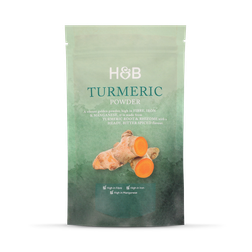
Holland & Barrett
£7.00
What is curcumin and what does it do?
The compound curcumin has been isolated by scientists as turmeric’s most active ingredient.2 Researchers have looked into curcumin’s anti-inflammatory properties but the jury's still out on this. That's because curcumin has poor bioavailability, so whether it could have any benefits when ingested is unclear.5 Between 3-5% of turmeric consists of curcuminoids, active plant compounds, most of which is curcumin.6
While there’s plenty of potential benefits associated with curcumin, the reason it’s not used more widely to treat conditions is that it’s not readily absorbed by the body.6
The link between turmeric and black pepper
Heard about taking turmeric and black pepper together? There’s a good reason. Scientists in one study discovered that black pepper helps absorb curcumin by up to 2000%, so you may sometimes find turmeric and black pepper together.6

What are the benefits of turmeric?
Another potential benefit of turmeric is that it may help to reduce the symptoms of joint pain, including symptoms suffered from different kinds of arthritis.6,7,8 Some research has shown that curcumin may be effective at treating symptoms of joint problems, such as joint function and pain.7 It wasn’t found to be effective at easing stiffness, however.6
Turmeric may also be able to help support digestion. A 2019 study involving 20 participants found turmeric might help with your gut microbiome, as it contains pre-biotics.9 But, as this study was small, further more robust studies are needed to fully understand how turmeric might affect your gut health.
As well as having soothing properties, turmeric is also said to have antioxidant properties, making it effective for skin types and conditions, such as blemish-prone skin and psoriasis. You can also use turmeric, or different variations of it, like face cleansers, skin masks and night creams within your skincare regimen.4,6 For glowing skin, why not give our lemon and turmeric face mask a go? You only need three ingredients to create it, it takes just six steps to make.
Turmeric FAQs
Fortunately, there’s lots of ways to use turmeric. Turmeric has been used in drinks for centuries, typically in either turmeric teas or coffees.2,6 You can do this with water (but it may not taste great) or you could add it to a smoothie so that it’s a little easier on the palette. Alternatively, turmeric milk is another popular drink.
There’s no reference nutrient intake (RNI) for turmeric, but be careful to not exceed the dosage stated on any label. For the best effect, you should have turmeric in combination with black pepper. Studies have found that an active compound in black pepper can promote the body’s ability to absorb curcumin by 2000%.6 Children under 12 years old and women who are pregnant or breastfeeding shouldn’t take turmeric, as its safety in these groups hasn’t been proven.
While they’re considered to be rare, some side effects of turmeric can include:6
The final say
Now you know what turmeric is and why it might be good for you, will you add it to your diet? You could try a warming golden milk or explore turmeric supplements to get started.
Disclaimer – This article provides informational advice and is not a substitute for medical care. Working with experts for accuracy, we take great care to ensure the information is up-to-date and relevant. However, you should always consult your GP or healthcare professional before using supplements or alternative products, particularly if you have medical conditions or are under supervision.
- Hay E, Lucariello A, Contieri M, Esposito T, De Luca A, Guerra G, Perna A. Therapeutic effects of turmeric in several diseases: An overview. Chemico-biological interactions. [Internet] 2019 Sep 1 [cited 2024 Jan 19];310:108729. Available at: https://www.sciencedirect.com/science/article/abs/pii/S0009279719308610
- turmeric | Description, History, & Uses [Internet]. Encyclopedia Britannica. [cited 2024 Jan 19]. Available from: https://www.britannica.com/plant/turmeric
- Verma RK, Kumari P, Maurya RK, Kumar V, Verma RB, Singh RK. Medicinal properties of turmeric (Curcuma longa L.): A review. Int. J. Chem. Stud. [Internet] 2018 [cited 2024 Jan 19];6(4):1354-7. Available at: https://d1wqtxts1xzle7.cloudfront.net/99716034/Avea_Depression_medicinal_20properties-libre.pdf?1678560001=&response-content-disposition=inline%3B+filename%3DMedicinal_properties_of_turmeric_Curcuma.pdf&Expires=1705663848&Signature=Fvz0Q0bijgNdx3--RsQEvrUZ6tCx1l62W7SK5kRw6gmBceU7MbVlP9fH9ck4NQ27ALM-tGHZ4bzGCMNGlJiISlUDDswOED6Hrt17ATWfBvO3gz3MopbDKrvlUydRfzE49wLye8KPcRdqXfgAX7L3dmQ-aDgYe-pwAdFNNX6X-tJrBpBksjHoI4dZ9OmExpE1wwmI-6621hiLRU8FWIRD~shJGbFOzcx4J0fZ4Kwupqqgv57FdG~9U8b5xDjXJ9xUMxnQiayxaXqe-y6ypxr~0uX7c~P3drmXhiGpzwb0eyoR64Sk15WIGTEc4yrvrXq15~EacToYiFz9pnTR7PSd3Q__&Key-Pair-Id=APKAJLOHF5GGSLRBV4ZA
- JAVANESE TURMERIC: Overview, Uses, Side Effects, Precautions, Interactions, Dosing and Reviews [Internet]. www.webmd.com. [cited 2024 Jan 19]. Available from: https://www.webmd.com/vitamins/ai/ingredientmono-532/javanese-turmeric
- Hewlings SJ, Kalman DS. Curcumin: A review of its effects on human health. Foods [Internet]. 2017 Oct 22 [cited 2024 Jan 19];6(10):92. Available at: https://www.mdpi.com/2304-8158/6/10/92
- Pulido-Moran M, Moreno-Fernandez J, Ramirez-Tortosa C, Ramirez-Tortosa M. Curcumin and health. Molecules [Internet]. 2016 Feb 25 [cited 2024 Jan 19];21(3):264. Available at: https://www.mdpi.com/1420-3049/21/3/264
- Panahi Y, Ali-Reza Rahimnia, Sharafi M, Gholamhossein Alishiri, Amin Saburi, Amirhossein Sahebkar. Curcuminoid Treatment for Knee Osteoarthritis: A Randomized Double‐Blind Placebo‐Controlled Trial. Phytotherapy Research [Internet]. 2014 May 22 [cited 2024 Feb 20];28(11):1625–31. Available from: https://pubmed.ncbi.nlm.nih.gov/24853120/
- Daily JW, Yang M, Park S. Efficacy of Turmeric Extracts and Curcumin for Alleviating the Symptoms of Joint Arthritis: A Systematic Review and Meta-Analysis of Randomized Clinical Trials. Journal of Medicinal Food [Internet]. 2016 Aug 1 [cited 2024 Feb 20];19(8):717–29. Available from: https://pubmed.ncbi.nlm.nih.gov/27533649/
- Peterson CT, Rodionov DA, Iablokov SN, Pung MA, Chopra D, Mills PJ, Peterson SN. Prebiotic potential of culinary spices used to support digestion and bioabsorption. Evidence-Based Complementary and Alternative Medicine [Internet]. 2019 Jun 2 [cited 2024 Jan 21];2019. Available at: https://www.hindawi.com/journals/ecam/2019/8973704/
- Vaughn AR, Branum A, Sivamani RK. Effects of turmeric (Curcuma longa) on skin health: a systematic review of the clinical evidence. Phytotherapy Research [Internet]. 2016 Aug [cited 2024 Jan 21];30(8):1243-64. Available at: https://onlinelibrary.wiley.com/doi/abs/10.1002/ptr.5640
- Barbalho SM, de Sousa Gonzaga HF, de Souza GA, de Alvares Goulart R, de Sousa Gonzaga ML, de Alvarez Rezende B. Dermatological effects of Curcuma species: a systematic review. Clinical and Experimental Dermatology [Internet]. 2021 Jul 1 [cited 2024 Jan 21];46(5):825-33. Available at: https://www.researchgate.net/profile/Nudrat-Fatima/publication/363250818_HAIR_INHIBITORY_EFFECT_ON_INTEGUMENTARY_ORGAN_BY_COMPOUND_ISOLATED_FROM_CURCUMA_LONGA_TURMERIC/links/63132d101ddd447021311084/HAIR-INHIBITORY-EFFECT-ON-INTEGUMENTARY-ORGAN-BY-COMPOUND-ISOLATED-FROM-CURCUMA-LONGA-TURMERIC.pdf
- Kwiecien S, Magierowski M, Majka J, Ptak-Belowska A, Wojcik D, Sliwowski Z, Magierowska K, Brzozowski T. Curcumin: a potent protectant against esophageal and gastric disorders. International journal of molecular sciences [Internet]. 2019 Mar 24 [cited 2024 Jan 21];20(6):1477. Available at: https://www.mdpi.com/1422-0067/20/6/1477


