 Track an order
 Buy It Again
 Favourites
 Manage account
 Rewards
 Subscriptions
 Find a store
 Help centre
The benefits of nature: how time outdoors supports your mental and physical health

Written byKatie Wright

Reviewed byJennifer Walsh

Reconnect with nature and feel the difference. From forest bathing to birdsong, discover simple ways green spaces can boost your mood, sharpen your mind and support your overall wellbeing
Summary
1Why does nature make you feel good?
Spending time in nature could help activate your senses, reduce stress and improve mood – especially after long periods indoors or on screens.
2What are the benefits of being outdoors?
Nature-based activities like walking or forest bathing may support mental wellbeing, heart health and sleep quality over time.
3How can you get more nature in your day?
Simple habits like getting outside, listening to birdsong or adding plants indoors could help you feel calmer and more refreshed.
From gazing out over a breathtaking forest view to the quiet joy of tending to your houseplants, nature can make us feel wonderful in so many ways.1 While bringing natural elements inside – just like the olive tree and leafy living wall you’ll find in our Battersea store – can have a stress-reducing effect.2
Nature and wellness expert and author of Walk Your Way Calm, Jennifer Walsh, offers her advice on the best ways to boost your body and mind with the help of green spaces.
Why does being in nature make you feel good?
There’s a reason so many people dream of escaping to the country. With more than half of the world’s population living in urban areas,3 venturing into green spaces feels like a refreshing change of scenery compared to the concrete jungle.
“The more screen time we have, the more green time we need”
“Since the industrial revolution, we've had this great migration indoors that's removed us from the things that make us feel our best,” says Jennifer. “We don't really get to activate our senses when we're indoors. Natural light, fresh flow and visual stimuli are how we activate our senses and that’s when the body flourishes.”
This is especially true if you’ve been staring at a computer screen all day. “The more screen time we have, the more green time we need,” Jennifer says.
The benefits of nature for body and mind
Not only is walking a great form of exercise, if you do it in a tree-filled area it can be a relaxing way to improve your mood and physical health. “Forest bathing, also known as shinrin-yoku, was coined in Japan in the 1980s,” says Jennifer. “It's a meditative practice of walking amongst trees very slowly.” Studies show that forest bathing might have a positive impact on things including heart health, immunity, depression and anxiety.4
“There's just a beautiful kind of synergy when you're walking with people outdoors”
Strolling through pine forests may offer gentle wellbeing benefits, Jennifer explains. Trees like pines release airborne compounds called phytoncides, and some research – particularly from Japan – has found an association between time spent in forests and increased activity of natural killer (NK) cells, which play a role in the immune system. In other words, breathing in forest air may have a small, short-term effect on certain immune markers.5
That said, it’s difficult to separate the impact of phytoncides from other factors, such as cleaner air, physical activity and reduced stress levels. Most studies are relatively small, so while spending time in nature can support overall wellbeing, it’s not a guaranteed way to support immunity or a replacement for established healthy habits. Be sure to take your headphones off too – hearing birdsong has been linked to lower levels of anxiety.6
Walking with a friend, loved one or colleague can be a great way to connect, too. Jennifer says, “There's just a beautiful kind of synergy when you're walking with people outdoors. Friendships build or work conversations tend to flow more beautifully.”
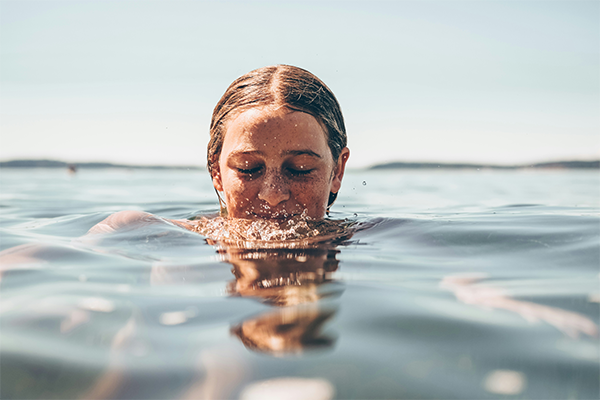
“Wild swimming has been linked to improvements in mood and reductions in negative emotions in some studies, though the evidence is still emerging. Likewise, research suggests that even looking at water may have a calming effect, with some studies finding small reductions in heart rate and blood pressure.”7,8
“Spending time in green spaces can sometimes mean exposure to cleaner air, which may benefit lung health by reducing contact with harmful pollution particles, though this varies depending on location and surrounding air quality”9
Getting outside in the sunlight, even if it’s just having your morning coffee in the garden, helps to regulate your circadian rhythm or internal body clock so you feel energised. “If you can fit it in first thing, it really helps set the stage for the rest of your day and may help you sleep better at night.”
Six ways to get closer to nature
Here are six ways to experience the wonder of nature, both outdoors and inside.
- Forest bathing – to turn a regular walk into a forest bath, slow down to a stroll and let your senses guide you. “What are the sounds you're hearing? What's the temperature like on your skin? Can you smell something in the air? And don't forget to touch the bark,” says Jennifer. You could even take your shoes off (if it’s safe to do so) to feel the earth beneath your feet
- Sea dips – a bracing plunge in the sea, even if you can only manage a couple of minutes – may help boost your mood. Cold water immersion has been linked to increases in feel-good chemicals like endorphins, similar to the effect of exercise, although research is still emerging10
- Outdoor exercise – switch up your gym or home workout routine. Why not grab a friend and do some yoga or a HIIT (high-intensity interval training) circuit in the park once in a while?
- Green mini meditations – the calming effects of nature can be fairly instant so you can ‘microdose’ without having to leave the house. “If you can see something natural from a window or even just look at your plants, it feels kind of like yoga for the brain”
- Listen to birdsong – if you can hear birds tweeting in the trees, fantastic, but research shows that even listening to recorded birdsong (from a white noise machine or YouTube video, for example) may improve mood5
- A scented shower – bring a forest aroma into your bathroom by hanging a few eucalyptus branches or lavender sprigs in your shower. The steam will release their fresh scent and awaken your senses
Benefits of nature FAQs
There's growing evidence that spending time in nature may support mental health, including helping to reduce levels of stress, anxiety and low mood.1,11
Being outside can feel calming as it engages the senses, which may encourage mindfulness and help reduce negative thoughts. Some research also suggests that looking at water can be particularly relaxing.
There's a growing body of research on forest bathing, with some studies suggesting it may support health and wellbeing. Findings indicate it can be associated with improvements in mood, reduced stress and anxiety, better sleep quality and potential effects on immune function.
Some research suggests that spending around 120 minutes a week in nature is associated with better health and wellbeing. However, even shorter periods, such as ten minutes a day spent sitting or walking in a natural setting, may offer small benefits for the mind and body.12,13
The final say
Spending time in green spaces, whether that’s vigorous exercise or simply relaxing and enjoying the sights, smells and sounds, can have many potential benefits for your physical and mental health. Plus, you don’t have to venture far to feel the effects.
“It doesn't take much time,” Jennifer says. “I always say if you can go outside for 15 minutes a day it really sets you up to be well for much longer.”
You can also use house plants and scents to bring a relaxing natural vibe into your everyday routine. Check out our selection of essential oils to infuse your home with a calming scent of your choice or learn about habit stacking to set you up for venturing into nature.
Disclaimer – The views expressed are those of Jennifer and are based on her professional experience. The advice in this article is for information only and should not replace medical care. Please check with your GP or healthcare professional before trying any supplements, treatments or remedies. Food supplements must not be used as a substitute for a varied and balanced diet and a healthy lifestyle.
1. Twohig-Bennett C, Jones A. The health benefits of the great outdoors: a systematic review and meta-analysis of greenspace exposure and health outcomes. Environ Res. 2018;166:628–637. doi:10.1016/j.envres.2018.06.030]
2. Nguyen J, Brymer E. Nature-based guided imagery as an intervention for state anxiety. J Environ Psychol. 2021;74:101577. doi:10.1016/j.jenvp.2021.101577
3. White MP, Elliott LR, Grellier J, Roberts B, Fleming LE. Associations between green/blue spaces and mental health across 18 countries. iScience. 2024;27:109960. doi:10.1016/j.isci.2024.109960
4. Antonelli M, Barbieri G, Donelli D. Effects of forest bathing (shinrin-yoku) on levels of cortisol as a stress biomarker: a systematic review and meta-analysis. Int J Biometeorol. 2019;63(8):1117–1134. doi:10.1007/s00484-019-01717-x
5. Liu H, Li F, Xu L, Han B. The effects of exposure to natural environments on mental health: a systematic review. Sci Rep. 2022;12:20075. doi:10.1038/s41598-022-20841-0
6. Shanahan DF, Astell-Burt T, Barber EA, Brymer E, Cox DTC, Dean J, et al. Nature-based interventions for improving health and wellbeing: the purpose, the people and the outcomes. Sports Med. 2019;49(8):—. doi:10.1007/s40279-019-01110-3
7. Zhang Y, Wu T, Yu H, Fu J, Xu J, Liu L, et al. Green spaces exposure and the risk of common psychiatric disorders: a meta-analysis. Environ Health Prev Med. 2023;28:—. doi:10.1265/ehpm.23-00000
8. Jimenez MP, DeVille NV, Elliott EG, Schiff JE, Wilt GE, Hart JE, et al. Associations between nature exposure and health: a review of the evidence. Int J Environ Res Public Health. 2021;18(9):4790. doi:10.3390/ijerph18094790]
9. Wang R, Feng Z, Pearce J, et al. Environmental exposure and health outcomes: a systematic review. Sci Total Environ. 2021;—:—. doi:10.1016/j.scitotenv.2021.147999
10. Reed EL, Chapman CL, Whittman EK, Park TE, Larson EA, Kaiser BW, et al. Cardiovascular and mood responses to an acute bout of cold water immersion. Physiol Behav. 2024;266:114234. doi:10.1016/j.physbeh.2023.114234
11. Coventry PA, Brown JV, Pervin J, et al. Nature-based outdoor activities for mental and physical health: systematic review and meta-analysis. SSM Popul Health. 2021;16:100934. doi:10.1016/j.ssmph.2021.100934
12. Bratman GN, Anderson CB, Berman MG, Cochran B, de Vries S, Flanders J, et al. Nature and mental health: an ecosystem service perspective. Sci Rep. 2019;9:—. doi:10.1038/s41598-019-44097-3
13. Kotera Y, Richardson M, Sheffield D. Effects of nature exposure on mental health: a systematic review. Front Psychol. 2019;10:2942. doi:10.3389/fpsyg.2019.02942


