 Track an order
 Buy It Again
 Favourites
 Manage account
 Rewards
 Subscriptions
 Find a store
 Help centre

Collagen is everywhere – but does it actually work? We asked a nutritionist to cut through the hype and reveal what collagen really does for your skin, joints and overall health
Summary
1What is collagen?
Collagen is known as an ‘elastic structural protein’, providing both strength and flexibility.
2What happens to collagen as we age?
We lose about 1-1.5% of our collagen every year, from around our mid-20s.
3How much collagen do we need per day?
Adequate intake is important, but more isn’t necessarily better – consistent use over time is best.
Confused about collagen? You’re not alone. Despite hearing a lot of hype, many of us are in the dark about what collagen actually does, what happens to our collagen reserves as we age and what collagen supplements do. That’s why we put questions to our in-house nutritionist, Alex Thompson – so you can discover everything from the science of collagen to why marine collagen might be one of the most effective forms around.
What is collagen?
"Collagen is known as an ‘elastic structural protein’, which means it provides both strength and flexibility to key parts of your body," says Alex. "For example, collagen keeps your bones strong but with a bit of flex, as brittle bones are more prone to breaking." Another ‘superpower’ of collagen is that it provides the body with amino acids like glycine and proline, which are needed to maintain and repair these tissues. Collagen sends signals between cells, helping them to repair damaged tissues in the body.1
Why is everyone seemingly so obsessed by collagen?
As well as providing the basis for many different tissues in our body, collagen also helps to form keratin, which Alex describes as: “the major structural protein in your hair. It’s also core to the formation of cartilage, which works as a shock absorber and allows free movement in your joints."2
What happens to collagen as we age?
Collagen loss is a natural part of the ageing process. We lose about 1-1.5% of our collagen every year, from around our mid-20s, according to researchers.3 “For most of our lives, men and women lose it at pretty much the same rate. But then women lose it faster during the first five years after menopause,” says Alex.
There are also lifestyle factors that speed up the declining rate of our collagen, like smoking,4 excessive drinking, eating a diet that’s high in sugar5 and too much sun exposure.6 “As our bodies produce less of it, our collagen fibres become weaker and can break down more easily.” This is why we get wrinkles, sagging skin, hair thinning and joint stiffness as we age – all the not-so-fun stuff. Losing collagen also lowers bone mass, making us more prone to stiffness and issues like osteoarthritis and osteoporosis as we age.7
“For most of our lives, men and women lose collagen at pretty much the same rate – until menopause, after which this loss is faster in women.”
So, are collagen supplements worth it?
According to this nutritionist, they may be a helpful addition. “By taking a collagen supplement, you’ll give your body more of those all-important specific amino acids, glycine and proline. They come with many potential health benefits,” continues Alex. Collagen is found in meat and fish, but the highest levels are found in animal skin, bones and connective tissues. “The majority of us aren’t nibbling on fish bones or connective ligaments very often, so that’s why supplementing might be a good idea.”
As for the key potential benefits currently being researched, these are wide-ranging. “By taking collagen regularly, you might see improved skin health – increased hydration and elasticity – and healthier hair and nails thanks to collagen’s role in keratin production. “Some emerging evidence suggests supplementation of collagen peptides may also support your joint health by helping to strengthen tendons and ligaments, and it might even help your muscles recover better after exercise.”8
How much collagen do we need per day?
“This depends on your main reason for supplementing,” says Alex, referencing goals such as plumper skin and post-exercise recovery. “While adequate intake is important, more isn’t necessarily better – benefits from collagen tend to depend on consistent use over time rather than higher doses,” says Alex, who also talks about the importance of taking it for the recommended duration (more on this later). “Once you go over 25g a day, you’ve saturated the benefits.”
Please refer to the product label on the acceptable dose of collagen as each product may vary. Please also speak to a healthcare professional before adding any new supplements to your diet.
Which is better – marine or bovine collagen?
Bovine collagen is made from cow bones and hides, while marine collagen comes from fish skin and scales – and both can be beneficial. “If you have dietary restrictions like an allergy, you’re pescatarian or you have religious or cultural exclusions, this might swing it for you,” says Alex. Most marine collagens are Halal but always check that the product has official Halal certification.
“Research has found that marine collagen is best for skin hydration,”9 he shares, adding that a high-quality collagen supplement shouldn’t taste fishy. You can also opt for vegan collagen. Instead of being sourced from animals, it’s made from genetically modified yeast and bacteria – which doesn’t sound appetising when you put it like that.
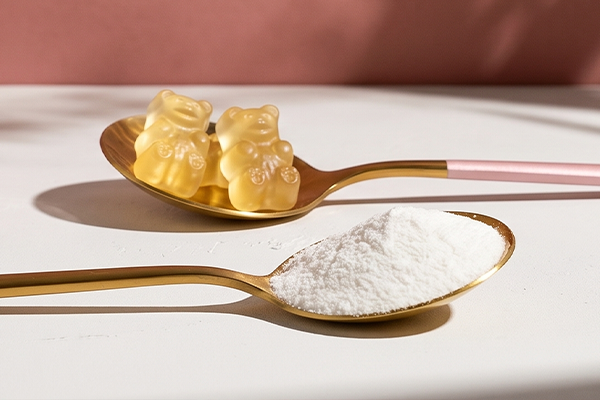
Are collagen gummies as good as powder?
“This depends on your particular focus and the amount of collagen you’re looking for. Gummies generally have less collagen per serving compared to powders. They also tend to be more expensive gram for gram.” But the choice is really down to what you prefer and will fit in with your daily habits, so that you take it consistently.
How long does collagen take to work?
“Based on a small study, to see a difference in your skin elasticity and hydration levels, you’ll want to take collagen supplements of up to 10g a day for at least eight weeks,” says Alex. “To see the post-exercise recovery benefits, researchers10 found that taking a high intake of 15-20g of collagen per day for just one week can have an effect. Or, like the study suggests, try 5g per day, and you could feel a difference within eight weeks, too.” For many of us, that means it's worth a try.
“Research shows that long-term sun exposure alters the structure of collagen in your skin”
Does the sun damage your collagen?
Yes, the sun does damage your collagen but not by simply stopping it from being produced. Research shows that long-term sun exposure alters the structure of collagen in your skin – turning what should be smooth, organised fibres into irregular, damaged ones.11 Although your skin continues to make collagen, it’s broken down and rebuilt in a disorganised way and some of it is replaced with abnormal elastic material. 11 This means the overall quality of collagen declines, which weakens the skin and contributes to wrinkles and loss of firmness over time.11
Collagen FAQs
Collagen isn’t absorbed by your body as a whole protein. Instead, during digestion it’s broken down into tiny pieces like amino acids and short peptides, which are small enough to pass through your gut into the bloodstream.12 From there, your body can use these building blocks wherever they’re needed, such as in your skin, joints or other tissues.12
There isn’t really a single ‘best’ time to take collagen – it’s more about what fits naturally into your routine, whether that’s in the morning, during the day or in the evening. The key point is consistency. Taking collagen regularly each day matters far more than the exact timing.
No, taking collagen alongside other proteins doesn’t appear to reduce absorption. Like other proteins, collagen is digested into amino acids and peptides and contributes to the overall pool of nutrients available in the body, rather than being treated separately. 13 In fact, protein ingestion in general simply increases amino acid availability, so collagen and other proteins effectively ‘add together’ rather than competing in a way that limits absorption.13
The final say
Whether you prefer collagen in your morning coffee, post-workout shake or evening routine, the key is finding a way to make it part of your everyday habits. Pair it with a balanced diet, support it with nutrients like vitamin C and give it time – because real results come from what you do consistently, not occasionally. Think of collagen as a long-term investment in your skin, joints and overall wellbeing. Hungry for some tasty ways to support your skin? Good news, sink your teeth into our skin-loving rocky road beauty roll or sip your way through this tropical beauty-boosting smoothie with vitamin C.
Disclaimer – This article provides informational advice and is not a substitute for medical care. Curated by experts for accuracy, we take great care to ensure the information is up-to-date and relevant. However, you should always consult your GP or healthcare professional before using supplements or alternative products, particularly if you have medical conditions or are under supervision.
1. Wu M, Crane JS. Biochemistry, Collagen Synthesis [Internet]. Nih.gov. StatPearls Publishing; 2019. Available from: https://www.ncbi.nlm.nih.gov/books/NBK507709/
2. Wang B, Yang W, McKittrick J, Meyers M. Keratin: Structure, mechanical properties, occurrence in biological organisms, and efforts at bioinspiration. Progress in Materials Science [Internet]. 2016;76:229–318. Available from: https://escholarship.org/uc/item/5sb7q6jp
3. Reilly DM, Lozano J. Skin collagen through the lifestages: importance for skin health and beauty. Plastic and Aesthetic Research. 2021 Jan 8;8(2).
4. Knuutinen A, Kokkonen N, Risteli J, Vähäkangas K, Kallioinen M, Salo T, et al. Smoking affects collagen synthesis and extracellular matrix turnover in human skin. The British Journal of Dermatology [Internet]. 2002 Apr 1;146(4):588–94. Available from: https://www.ncbi.nlm.nih.gov/pubmed/11966688
5. Nguyen HP, Katta R. Sugar Sag: Glycation and the Role of Diet in Aging Skin. Skin Therapy Letter [Internet]. 2015 Nov 1;20(6):1–5. Available from: https://pubmed.ncbi.nlm.nih.gov/27224842/
6. Goodman GD, Kaufman J, Day D, Weiss R, Kawata AK, Garcia JK, et al. Impact of Smoking and Alcohol Use on Facial Aging in Women: Results of a Large Multinational, Multiracial, Cross-sectional Survey. The Journal of Clinical and Aesthetic Dermatology [Internet]. 2019 Aug 1;12(8):28–39. Available from: https://www.ncbi.nlm.nih.gov/pmc/articles/PMC6715121/
7. Shuster S. Osteoporosis, like skin ageing, is caused by collagen loss which is reversible. Journal of the Royal Society of Medicine. 2020 Apr;113(4):158–60.
8. Khatri M, Naughton RJ, Clifford T, Harper LD, Corr L. The effects of collagen peptide supplementation on body composition, collagen synthesis, and recovery from joint injury and exercise: a systematic review. Amino Acids [Internet]. 2021;53(10):1493–506. Available from: https://www.ncbi.nlm.nih.gov/pmc/articles/PMC8521576/
9. Geahchan S, Baharlouei P, Rahman A. Marine Collagen: A Promising Biomaterial for Wound Healing, Skin Anti-Aging, and Bone Regeneration. Marine Drugs. 2022 Jan 10;20(1):61.
10. Campos LD, de Almeida Santos Junior V, Pimentel JD, Fernandes Carregã GL, Betim Cazarin CB. Collagen supplementation in skin and orthopedic diseases: A review of the literature. Heliyon [Internet]. 2023 Mar;9(4):e14961. Available from: https://www.cell.com/action/showPdf?pii=S2405-8440%2823%2902168-0
11. Bernstein EF, Chen YQ, Kopp JB, Fisher L, Brown DB, Hahn PJ, et al. Long-term sun exposure alters the collagen of thepapillary dermis. Journal of the American Academy of Dermatology. 1996 Feb;34(2):209–18.
12. Campos LD, de Almeida Santos Junior V, Pimentel JD, Fernandes Carregã GL, Betim Cazarin CB. Collagen supplementation in skin and orthopedic diseases: A review of the literature. Heliyon. 2023 Mar;9(4):e14961.
13. Holwerda AM, van Loon LJC. The impact of collagen protein ingestion on musculoskeletal connective tissue remodeling: a narrative review. Nutrition Reviews. 2021 Oct 4;80(6).
Related to this article


