20% off £40 or 15% off £30
 Track an order
 Buy It Again
 Favourites
 Manage account
 Rewards
 Subscriptions
 Find a store
 Help centre


Wondering how long it really takes to lose weight? Let’s break the myths, embrace your journey and find a pace that works for you with help from a nutritionist
Summary
1What affects how long it takes to lose weight?
Wouldn’t it be wonderful if weight loss looked the same for everyone? The truth is, it doesn’t…
2Factors that could slow your weight loss down
As you lose weight, your body adapts. Your resting energy requirements decrease…
3How to speed up weight loss
While you can’t change things like your age or biological sex, there’s still a lot within your control…
Losing weight isn’t one-size-fits-all and the timeline can feel frustratingly slow – or surprisingly fast – depending on a mix of factors. While many wonder how much weight is realistic to lose each week, it’s just as important to understand what can slow your progress and what strategies can safely help you speed it up.
“Even the smallest weight loss can make a meaningful difference to your health,” says nutritionist Olivia Rosenvinge. “Losing just a little can support healthier blood sugar levels, improve blood pressure and help reduce key risk factors linked to heart health.”1 With help from Olivia, we broke it all down so you can set realistic goals and take control of your weight-loss journey.
What affects how long it takes to lose weight?
Wouldn’t it be wonderful if weight loss looked the same for everyone? The truth is, it doesn’t – and that’s okay. Everybody is different and your weight-loss journey is shaped by many factors, including your biology, hormones and everyday lifestyle.2
This means progress can look faster for some and slower for others, without saying anything about your effort or commitment. People with higher starting weights may see bigger initial changes, but weight loss often slows as the body adapts. Understanding what influences your body can help you set realistic expectations, stay motivated and avoid unnecessary frustration along the way.
Age
As we get older, weight loss can feel more challenging and that’s not a personal failing. “Metabolic changes with age can affect energy needs and weight loss speed. Older adults often have lower resting metabolic rates due to natural loss of muscle mass,” says Olivia. “But this doesn’t mean weight loss isn’t possible. Focusing on strength, activity and nutrition tailored to your needs can keep progress steady.”3
On top of that, busy lives filled with work, family and responsibilities often leave less time and energy for exercise and movement. Understanding these changes allows you to adapt your approach, work with your body and focus on progress that fits your life right now.4
Gender
In many studies, women on average tend to lose weight more slowly than men – and that’s mostly due to natural differences in body composition and metabolism. “Men generally lose weight faster than women in equivalent programs because of higher muscle mass and resting metabolic rate,” says Olivia. “Women tend to carry more body fat proportionally, which can slow loss relative to men, not because of effort or willpower.”5 These biological differences can influence how weight changes with the same diet or exercise plan. At the same time, everyone’s body and lifestyle are unique, so experiences with weight loss can still vary widely from person to person.6
How your starting weight affects progress
Olivia explains it best: “Those with more weight to lose often see faster initial changes, but the percentage of body weight lost is a better benchmark.” What’s really happening is that each pound represents a larger percentage of your body weight at the start and a smaller percentage later on. “Achieving 5% of your initial body weight is considered clinically meaningful and is linked to significant health improvements,” she continues. Health conditions can also influence how your body responds and how active you’re able to be.
Activity and exercise
Moving more – whether that’s a regular exercise class, a walk with a podcast or simply being more active in day-to-day life – can genuinely support weight loss. And no, it doesn’t have to mean punishing gym sessions. Research shows that exercise training, whether it’s brisk walking, cycling or other forms of activity, is associated with modest but real reductions in body weight and body fat when compared to doing no training at all. It also helps reduce harmful visceral fat deep around your organs, which is great for overall health, even if the number on the scale doesn’t drop dramatically. That means that staying as active as you can, while eating in a way that suits your goals, gives your body extra tools to succeed. Even small increases in daily movement add up and can make your efforts more effective and sustainable over time.7,8
“Adequate sleep and stress management are crucial. Try to prioritise seven to nine hours of quality sleep per night”
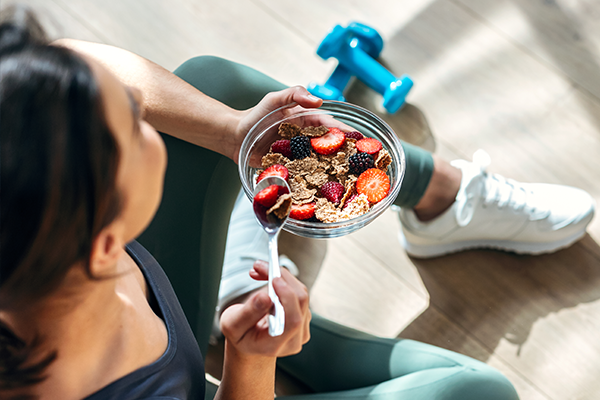
Lifestyle
Research has shown that social networks, stress, eating patterns, sleep and routines all play into long-term weight changes, not just short-term diets.9 “Adequate sleep and stress management are crucial. Insufficient sleep is linked to slower weight loss and higher chances of regain,” says Olivia. “Try to prioritise seven to nine hours of quality sleep per night.”10
Patience and consistency
How you approach weight loss matters just as much as what you do. Progress rarely happens overnight and lasting change is built through patience and steady, consistent habits. Being realistic with your expectations and sticking with a sensible plan helps your body adapt and makes weight loss easier to maintain over time.
“As you lose weight, your body adapts. Your resting energy requirements decrease and metabolism slows. This plateau is normal and doesn't indicate failure”
Factors that could slow your weight loss down
As your body changes, your needs change too. If you’re still eating the same amount you did when you were heavier, your body may simply be getting the fuel it now requires to maintain its new weight. “As you lose weight, your body adapts. Your resting energy requirements decrease and metabolism slows. This plateau is normal and doesn’t indicate failure,” says Olivia.11 “You’ll naturally need fewer calories, so gently adjusting your intake can help keep progress moving forward.”
It’s also worth checking in with your activity levels. Have your daily steps dropped? Has everyday movement or structured exercise slipped out of your routine? Even small increases in movement, like more walking, more consistency with workouts or simply sitting less, can re-energise weight loss.
How to speed up weight loss
While you can’t change things like your age or biological sex, there’s still a lot within your control. Start by checking in with your current body weight and making sure your calorie intake still reflects it. As your body gets lighter, maintaining a gentle calorie deficit may mean adjusting your portions or food choices. Movement also matters. Look for simple, sustainable ways to be more active. Strength training is especially important during weight loss. Holding on to muscle helps keep your metabolism higher, which supports ongoing progress and overall strength.
Finally, take a step back and look at your lifestyle and routine. Are there small barriers making things harder than they need to be? Simple changes, like keeping nourishing foods visible and tempting snacks out of sight, can make healthy choices easier. Prioritise good-quality sleep, stay well hydrated and be patient with yourself. Progress will come, even if it’s slower than you’d like. What matters most is that it’s steady and sustainable.
Weight-loss FAQs
For most people, aiming to lose about one to two pounds (0.5–1 kg) per week is considered a healthy and realistic pace. This steady rate is linked with better long-term success and makes it easier to keep weight off compared with trying to drop pounds too quickly.12 Rather than focusing only on a fixed number of pounds, another helpful way to think about progress is in terms of percent of your current weight. That helps keep expectations grounded as your body adapts to a new, lower weight without undue pressure or frustration.12
The 3-3-3 rule for weight loss is a simple, flexible approach that focuses on building healthy habits without strict rules or deprivation. It’s designed to fit into real life and be sustainable long-term. It’s based on three easy ideas: eating three balanced meals a day to keep your energy steady, drinking three bottles of water by 3 p.m. (about 1.5–2 litres) to support hydration and reduce mindless snacking, and getting three hours of movement each week in a way that feels good to you.
When you lose weight, your body begins to use stored fat for energy, which causes fat cells to shrink.13 Much of this process happens naturally as your body burns fuel and releases byproducts like carbon dioxide and water. Along the way, many people notice positive changes such as feeling more energetic, sleeping better or finding everyday movement easier.14 Some also experience improvements in things like blood pressure or blood sugar levels, though this can vary from person to person.11
Weight loss can come with challenges too. Hunger may increase at times as your body adjusts11 and changes in body shape (like loose skin) can happen, especially with larger or faster weight loss. That’s why focusing on nourishing your body and including strength-based movement can be helpful, as it supports muscle and overall health.
The final say
Weight loss is a personal journey and there’s no single timeline that fits everyone. By understanding the factors that influence your progress and focusing on consistency, healthy habits and realistic goals, you can move forward with confidence. Wondering if you can target love handles? Here’s what the experts say. Curious about adding more protein to your diet? Discover how it can support muscles and movement. Celebrate small wins, stay patient with yourself and keep using what works.
Disclaimer – This article provides informational advice and is not a substitute for medical care. Curated by experts for accuracy, we take great care to ensure the information is up-to-date and relevant. However, you should always consult your GP or healthcare professional before using supplements or alternative products, particularly if you have medical conditions or are under supervision.
1. Dhar D, Packer J, Michalopoulou S, Cruz J, Stansfield C, Viner RM, et al. Assessing the evidence for health benefits of low-level weight loss: a systematic review. International Journal of Obesity. 2024 Nov 1;
2. National Institute of Diabetes and Digestive and Kidney Diseases. Factors Affecting Weight & Health [Internet]. National Institute of Diabetes and Digestive and Kidney Diseases. 2019. Available from: https://www.niddk.nih.gov/health-information/weight-management/adult-overweight-obesity/factors-affecting-weight-health
3. Yano T, Godai K, Kabayama M, Akasaka H, Takeya Y, Yamamoto K, et al. Factors associated with weight loss by age among community-dwelling older people. BMC Geriatrics. 2023 May 6;23(1).
4. National Institute on Aging. Maintaining a healthy weight [Internet]. National Institute on Aging. 2022. Available from: https://www.nia.nih.gov/health/healthy-eating-nutrition-and-diet/maintaining-healthy-weight
5. Henderson J, Ehlers AP, Lee JM, Kraftson AT, Piehl K, Richardson CR, et al. Weight Loss Treatment and Longitudinal Weight Change Among Primary Care Patients With Obesity. JAMA network open [Internet]. 2024 Feb 15 [cited 2024 Feb 22];7(2):e2356183–3. Available from: https://jamanetwork.com/journals/jamanetworkopen/fullarticle/2815174
6. Susanto A, Burk J, Hocking S, Markovic T, Gill T. Differences in weight loss outcomes for males and females on a low-carbohydrate diet: A systematic review. Obesity Research & Clinical Practice. 2022 Nov;16(6):447–56.
7. Bellicha A, Baak MA, Battista F, Beaulieu K, Blundell JE, Busetto L, et al. Effect of exercise training on weight loss, body composition changes, and weight maintenance in adults with overweight or obesity: An overview of 12 systematic reviews and 149 studies. Obesity Reviews [Internet]. 2021 May 6;22(S4). Available from: https://www.ncbi.nlm.nih.gov/pmc/articles/PMC8365736/
8. Leitzmann M. Physical activity, sedentary behaviour, and obesity [Internet]. Nih.gov. International Agency for Research on Cancer; 2017. Available from: https://www.ncbi.nlm.nih.gov/books/NBK565813/?utm_source=chatgpt.com
9. Feraco A, Lombardo M, Armani A. The Effect of Lifestyle and Eating Habits on Obesity. Nutrients [Internet]. 2025 Mar 12;17(6):993–3. Available from: https://pmc.ncbi.nlm.nih.gov/articles/PMC11946202/
10. Bogh AF, Jensen SBK, Juhl CR, Janus C, Sandsdal RM, Lundgren JR, et al. Insufficient sleep predicts poor weight loss maintenance after 1 year. Sleep. 2023;46(5):zsac295. doi:10.1093/sleep/zsac295.
11. Martins C, Roekenes JA, Rehfeld JF, Hunter GR, Gower BA. Metabolic adaptation is associated with a greater increase in appetite following weight loss: a longitudinal study. American Journal of Clinical Nutrition. 2023 Oct 19;118(6):1192–201.
12. Centers for Disease Control and Prevention. Steps for Losing Weight [Internet]. Healthy Weight and Growth. 2024. Available from: https://www.cdc.gov/healthy-weight-growth/losing-weight/index.html
13. Medicine N. How Your Body Fights Weight Loss [Internet]. Northwestern Medicine. 2022. Available from: https://www.nm.org/healthbeat/healthy-tips/how-your-body-fights-weight-loss
14. NHS . Self-help Tips to Fight Tiredness - Sleep and Tiredness [Internet]. NHS. 2019. Available from: https://www.nhs.uk/live-well/sleep-and-tiredness/self-help-tips-to-fight-fatigue/
Related to this article


