20% off £40 or 15% off £30
 Track an order
 Buy It Again
 Favourites
 Manage account
 Rewards
 Subscriptions
 Find a store
 Help centre
What causes warts on fingers and what can you do about them?

Written byMedico Digital

Reviewed byDr Guy Ratu, (GPwER) in Dermatology

Spotted an unusual bump on your finger? It may well be a wart. But did you know how these troublesome bumps come about, and how you can zap them away with easy at-home fixes?
Summary
1What are finger warts?
Warts are nothing to be ashamed of. They’re a viral skin condition that’s easy to catch, and almost everyone gets one at some point in their life…
2Are warts on fingers contagious?
Yes, warts are contagious and can spread directly or indirectly – from person to person or through contact with contaminated surfaces…
3Preventing and treating warts
One thing’s for sure – warts have a mind of their own and, if left untreated, they can easily spread…
Warts may be harmless, but let’s face it – they can be a real pain, especially when they pop up on your hands and fingers. Not only are they annoying when we go about our daily lives, but for some people, they can feel pretty embarrassing too, given how visible they can be.1,2 You might also worry about them spreading to other parts of your body or your family members.3
Thankfully, understanding what warts are, how they appear and the best ways to keep them at bay will have you managing them like a pro in no time. Let’s dig deeper...
What are finger warts?
Warts are nothing to be ashamed of. They’re a viral skin condition that’s easy to catch, and almost everyone gets one at some point in their life.1,3
They’re especially common on the hands and fingers, and while harmless, that can be a real annoyance considering how often we use our hands.4,5
What do warts on fingers look like?
Warts on your fingers typically:1,6
- feel firm and rough to touch
- are usually raised like bumps (though some warts are flat)
- might appear as one lump or a cluster over your hand or fingers
- tend to match your skin tone, but might be darker on black or brown skin
That’s right – warts come in all shapes and sizes. Here’s a quick guide to the most common types you might spot on your fingers or hands:
It may be a periungual wart, which can develop under and around fingernails. They’re rough, may affect the shape and normal growth of your nail and can be painful.5,7 They are likely to arise due to skin biting or pricking.8
Flat warts (also called plane warts) tend to appear in groups, sometimes clustering into as many as several hundred warts. True to their name, they’re round and flat, usually smooth, yellowish in colour and about 2 to 4mm each in diameter.5
The kind of wart that first comes to our heads – common warts feel like rough bumps and are most often found on the back of hands and fingers.6,9 In particular, they tend to appear in areas where the skin may be broken, like near the fingernails.6
What causes warts on fingers?
The human papillomavirus (HPV) is the culprit here – a type of virus that can infect the top layer of your skin.4 If your immune system doesn’t fight it off, the virus triggers extra cell growth, causing the skin’s outer layer to thicken and harden, eventually forming a wart.7
Anyone can get warts, but people who bite their nails or pick at hangnails are at a higher risk. That’s because it’s easier for the virus to enter your body through cuts or scrapes.3
Are warts on fingers contagious?
Yes, warts are contagious and can spread directly or indirectly – from person to person or through contact with contaminated surfaces.3 You can catch them by touching a wart on someone else’s body or even by handling something a wart has touched, like a towel.3 Warts can also spread on your own body, especially if you scratch, bite or suck the area.5
While it’s virtually impossible to completely avoid warts, don’t worry – there are certain things you can do to keep them from spreading. Let’s get into it.
Preventing and treating warts
One thing’s for sure – warts have a mind of their own and, if left untreated, they can easily spread.3
To prevent warts from spreading on your hands, or to other people:1,10
- don’t scratch or pick at your warts, or suck on fingers with warts
- don’t bite your nails as this could let the wart virus (HPV) in
- don’t touch other people’s warts
- don’t share towels or other personal items if you have a wart
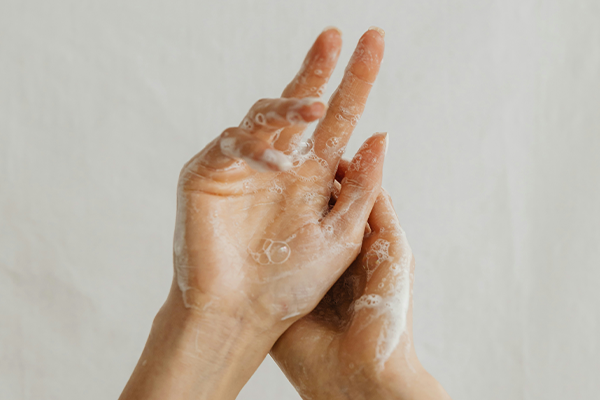
Washing your hands thoroughly after touching your wart can also help to prevent warts from spreading.1
At-home remedies
Warts usually go away on their own, but this may take months – or even years.1 Here are a couple of natural methods you can try in the meantime.
You might have heard of the salicylic acid method. This common cosmetic works by breaking down the wart itself and may also trigger an immune response in the body.11,12
Salicylic acid can be bought from shops or online as a gel, liquid or plaster, and you can use it to treat your wart every day. Before doing so, soak your hand in warm water and use an emery file or pumice stone to gently rub off the very top layer of dead skin. Then apply the salicylic acid.13,14
If doing this makes your skin feel sore, you should stop for a while. If it seems fine to go ahead, don’t expect instant results – it’s a slow process that can take months.14
Research suggests that applying tea tree oil may help clear warts. However, we still need more studies to look for any possible long-term effects.15
The final say
Warts on the fingers are harmless and are unlikely to stay with you for life.1 But let’s be honest – they can be incredibly frustrating.
If you’re looking for more ways to wave goodbye to your warts for good, a doctor or pharmacist should be able to help – or check out our wart removal guide.1
Disclaimer - This article provides informational advice and is not a substitute for medical care. Curated by experts for accuracy, we take great care to ensure the information is up-to-date and relevant. However, you should always consult your GP or healthcare professional before using supplements or alternative products, particularly if you have medical conditions or are under supervision.
1. NHS. Warts and verrucas [Internet]. [cited 2025 Jan 2]. Available from: https://www.nhs.uk/conditions/warts-and-verrucas/
2. Molla A, et al. Comparative Analysis of Intralesional Immunotherapy and Conventional Treatments for Non-Genital Warts: A Systematic Review and Network Meta-Analysis. Dermatol Pract Concept. 2024;14(3):e2024215. https://doi.org/10.5826/dpc.1403a215
3. American Academy of Dermatology. Warts: Who gets and causes [Internet]. [cited 2025 Jan 2]. Available from: https://www.aad.org/public/diseases/a-z/warts-causes
4. American Academy of Dermatology. Warts: Overview [Internet]. [cited 2025 Jan 2]. Available from: https://www.aad.org/public/diseases/a-z/warts-overview
5. NHS inform. Warts and verrucas [Internet]. [cited 2025 Jan 26]. Available from: https://www.nhsinform.scot/illnesses-and-conditions/skin-hair-and-nails/warts-and-verrucas/
6. American Academy of Dermatology. Warts: Signs and symptoms [Internet]. [cited 2025 Jan 2]. Available from: https://www.aad.org/public/diseases/a-z/warts-symptoms
7. Wang X, et al. Fingertip soft tissue defect caused by periungual warts: A case report. Clin Case Rep. 2023;11(10):e7866. https://doi.org/10.1002/ccr3.7866
8. Satasia M, Sutaria AH. Nail whispers revealing dermatological and systemic secrets: An analysis of nail disorders associated with diverse dermatological and systemic conditions. Cureus. 2023;15(9):e45007. https://doi.org/10.7759/cureus.45007
9. Primary Care Dermatology Society. Warts [Internet]. [cited 2025 Jan 2]. Available from: https://www.pcds.org.uk/clinical-guidance/warts
10. American Academy of Dermatology. Warts: How to heal warts more quickly and prevent new ones [Internet]. [cited 2025 Jan 2]. Available from: https://www.aad.org/public/diseases/a-z/warts-heal
11. Kore VB, Anjankar A. A comprehensive review of treatment approaches for cutaneous and genital warts. Cureus. 2023;15(10):e47685. https://doi.org/10.7759/cureus.47685
12. Truong K, et al. Destructive therapies for cutaneous warts: A review of the evidence. Aust J Gen Pract. 2022;51(10):799–803. https://doi.org/10.31128/ajgp-01-22-6305
13. American Academy of Dermatology. Warts: Tips for managing [Internet]. [cited 2025 Jan 2]. Available from: https://www.aad.org/public/diseases/a-z/warts-self-care
14. NHS Scotland. The long house surgery. Warts [Internet]. [cited 2025 Jan 2]. Available from: https://www.longhousesurgery.scot.nhs.uk/clinics-and-services/warts/ 15. Boopalan D, et al. Topical application of tea tree oil for the treatment of verruca vulgaris. JMIR Dermatol. 2023;6:e47107. https://doi.org/10.2196/47107
Related to this article


