20% off £40 or 15% off £30
How gut health can affect inflammation in the body

Written byJodi M Johnson

Reviewed byHeeral Tomlinson

Bloating, brain fog, sore joints? Chronic inflammation might not start with diet or stress – it could begin in your gut. Here’s how your microbiome could be fueling the fire
Summary
1What is inflammation and is it a problem?
Inflammation isn’t always a bad thing – it’s actually your body’s natural way of healing itself when you get hurt or sick.
2What is an ‘anti-inflammatory diet’?
An ‘anti-inflammatory diet’ isn’t a strict or officially recognised diet and there’s no single food that can switch inflammation on or off.
3How to support your gut bacteria and inflammation
Simple lifestyle habits like managing stress, staying active and enjoying a balanced, varied diet can make a real difference.
Your gut might be quietly shaping more of your health than you realise. When the balance of bacteria in your gut is off, it can spark inflammation – but there are ways to help bring things back in harmony. We’ve looked at how your gut microbiome and inflammation are linked, what the science really says and easy, practical changes you can make to your diet to support a healthier, happier gut and body.
What is inflammation and is it a problem?
Inflammation isn’t always a bad thing – it’s actually your body’s natural way of healing itself when you get hurt or sick.1 The trouble starts when inflammation sticks around longer than it should.1 This ‘chronic inflammation’ can quietly contribute to serious health issues over time, including heart disease, autoimmune conditions and metabolic problems.1
While chronic inflammation tends to increase as we get older, it’s not just part of ageing. Chronic inflammation is also linked to weight gain, low energy, trouble sleeping, reduced libido, brain fog and even mood changes like depression.1,2,3,4,5 Doctors can spot it through certain markers in the blood, such as IL-6, TNF-α and C-reactive protein (CRP), so it’s always best to see a GP if you have these symptoms.6
Acute vs chronic inflammation
There are two main types of inflammation: acute and chronic.
Acute inflammation comes on quickly in response to injury or infection and usually settles within a few days.7 You might notice pain, redness, swelling, heat8 or difficulty moving the area – all signs that your immune system is doing its job and helping you heal.7
Chronic inflammation is different. It lasts for weeks, months or even longer and happens when the body’s response doesn’t properly switch off.7 Over time, this can contribute to health problems.7 If you’re experiencing ongoing symptoms or are concerned about inflammation, it’s important to speak to your GP for advice and support.
The gut-inflammation connection
Your gut is home to a bustling community of bacteria – some helpful, some not so much.9 Thanks to research, we’re learning more about how this microbiome can influence inflammation in the body. A major 2020 review found that while certain bacteria may trigger inflammation, others seem to help keep it in check. However, scientists are still figuring out exactly which strains are the ‘good guys’, so there’s more research needed.10
“Studies suggest that balancing these bacteria may help manage inflammation in the gut”
Research has also shown that gut bacteria play a key role in conditions like inflammatory bowel disease (IBD), Crohn’s and ulcerative colitis. Studies suggest that balancing these bacteria may help manage gut inflammation and potentially make a difference for some people.11
What is an ‘anti-inflammatory diet’?
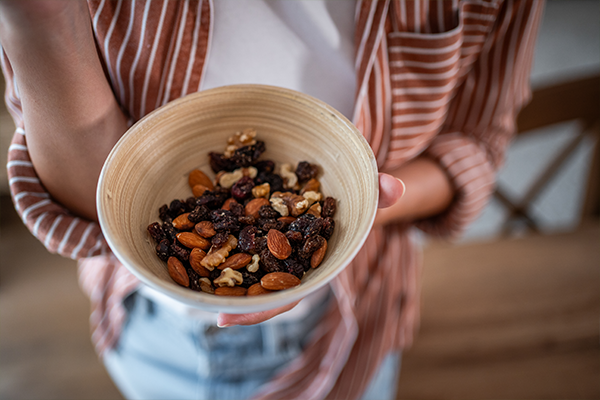
An ‘anti-inflammatory diet’ isn’t a strict or officially recognised diet and there’s no single food that can switch inflammation on or off.12 While some lab studies suggest certain foods may have anti-inflammatory properties – and others, like highly processed or high-fat, salt and sugar (HFSS) foods and processed meats, may promote inflammation – most of this research hasn’t been done in people.12 So rather than focusing on ‘superfoods’, it’s more helpful to look at your overall eating pattern.
In general, foods often described as anti-inflammatory include fruit and vegetables, wholegrains, lentils, beans, nuts, seeds, oily fish and fermented foods.12 These are all part of a balanced, nourishing way of eating – think along the lines of the Eatwell Guide. Well-researched dietary patterns such as the DASH and Mediterranean diets follow this approach. They emphasise plant foods, including fish, beans and nuts, using olive oil instead of saturated fats and limit sugary foods, fatty meats and heavily processed products.13 If you’re thinking about making changes, especially if you have a health condition, it’s always a good idea to speak with a GP or dietitian so you can find an approach that works for you.
How to support your gut bacteria and inflammation
There’s plenty we can do to support a healthy gut and keep inflammation in check. Simple lifestyle habits like managing stress, staying active and enjoying a balanced, varied diet can make a real difference. Many whole foods naturally fight inflammation – and there are even more dietary tweaks you can make to help your gut thrive and keep inflammation under control.
Diversify your diet
Eating a wide variety of colourful fruits and vegetables isn’t just great for your taste buds – it also feeds your gut in ways that support a richer, more resilient microbiome. The more different types of foods you enjoy, the more kinds of microbes your gut can nurture, which is linked with better overall gut health and adaptability. Studies have shown that a diverse diet helps create a more complex community of gut bacteria – something that’s associated with improved health outcomes. This is because each food provides unique nutrients that feed different microbes.14,15 P.S. microbes love fibre-rich foods (like our ginger tadka dal) and bananas, asparagus, onions, garlic, leeks and oats.16
Introduce healthy fats and protein
Including lean proteins, healthy fats, whole grains, legumes, nuts and seeds gives your microbiome a variety of nutrients to work with. Studies suggest that the types of fats and nutrients you eat can shape your gut bacterial community, sometimes increasing bacteria that are considered beneficial and helping maintain a healthy microbial balance. For example, research has found that diets higher in fats (especially certain healthy fats) are linked with changes in gut microbes, including increases in some bacterial groups that thrive on those fats – though the full picture is still being unravelled.17
Limit ultra-processed foods
Cutting back on ultra-processed foods (UPFs) like ready meals high in salt, artificial ingredients and added sugars – isn’t just about eating 'cleaner', it’s about helping your gut stay balanced and calm. Research shows that additives commonly found in UPFs, including artificial sweeteners and emulsifiers, can disrupt the gut microbiome, reduce beneficial bacteria and potentially contribute to inflammation and digestive issues. Choosing minimally processed foods instead gives your gut microbes the kinds of nutrients they thrive on and helps support your digestive health. But that doesn’t mean you shouldn’t enjoy the foods you love from time to time.18
“Adding fermented foods to your meals is a delicious way to support your gut’s microbial community”
Diversify your gut microbiome
Adding fermented foods to your meals is a delicious way to support your gut’s microbiome. Foods like natural yoghurt, kefir, miso, sauerkraut, kimchi, other fermented veggies, kombucha and aged cheeses introduce a mix of live microbes and fermentation by-products that can help shape your gut microbiome in positive ways. Studies show that people who regularly eat fermented foods tend to have different (and often more diverse) gut bacteria compared with those who don’t, hinting at shifts in microbial balance that may support digestion and overall wellness.19
Consider taking supplements
Along with nourishing your body through food, you might choose to support your gut with a broad-spectrum probiotic supplement – these contain a mix of beneficial bacteria that can help keep your microbiome balanced. Some people also find that omega-3 supplements (from fish oil or algae) are helpful, as these essential fatty acids are known for their anti-inflammatory benefits and overall support for heart, brain and immune health.20
Inflammation FAQs
Inflammation is your body’s natural response to protect and heal itself. It can be triggered by infections like bacteria or viruses, injuries such as cuts or splinters or exposure to harmful substances.21 Many conditions linked to inflammation end in ‘-itis’, which simply means inflammation, such as bronchitis or dermatitis.21
- Diarrhoea that lasts more than four weeks
- Stomach or tummy pain
- Blood or clear mucus in your stool
- Bleeding from your bottom
- Feeling constantly tired or low on energy
- Unexplained weight loss
These symptoms may be caused by a range of other conditions, so it’s important to consult your GP for a proper evaluation and diagnosis.22
You can help calm inflammation in your body not just by eating well but also by adopting healthy habits in everyday life. Alongside a balanced, ‘anti-inflammatory diet’ rich in fruits, vegetables, whole grains, oily fish and healthy oils – quitting smoking, staying physically active and keeping a healthy weight all help reduce inflammation and support your overall health.12
The final say
When you understand how closely your gut and inflammation are linked, things start to feel less confusing. Nurturing your gut with nourishing foods can help your body settle and feel more like itself again. If you’re ready for more tummy talk, then learn about how your gut affect the rest of your body or read up on the gut-brain axis to learn how your gut and brain are connected.
Disclaimer – This article provides informational advice and is not a substitute for medical care. Curated by experts for accuracy, we take great care to ensure the information is up-to-date and relevant. However, you should always consult your GP or healthcare professional before using supplements or alternative products, particularly if you have medical conditions or are under supervision.
1. Hirano T. IL-6 in inflammation, autoimmunity and cancer. International immunology. 2021. Available at: https://academic.oup.com/intimm/article/33/3/127/6041650
2. Louati K, Berenbaum F. Fatigue in chronic inflammation - a link to pain pathways. Arthritis Research & Therapy [Internet]. 2015 Oct 5 [cited 2019 Sep 17];17(1). Available from: https://www.ncbi.nlm.nih.gov/pmc/articles/PMC4593220/
3. Engert LC, Besedovsky L. Sleep and inflammation: a bidirectional relationship. Somnologie. 2025 Jan 27;29.
4. Lorenz TK. Interactions Between Inflammation and Female Sexual Desire and Arousal Function. Current Sexual Health Reports. 2019 Oct 28;
5. Hanafy KA, Jovin TG. Brain FADE syndrome: the final common pathway of chronic inflammation in neurological disease. Frontiers in Immunology [Internet]. 2024 Jan 18;15. Available from: https://www.ncbi.nlm.nih.gov/pmc/articles/PMC10830639/
6. Del Giudice M, Gangestad SW. Rethinking IL-6 and CRP: Why they are more than inflammatory biomarkers, and why it matters. Brain, Behavior, and Immunity [Internet]. 2018 May;70:61–75. Available from: https://pubmed.ncbi.nlm.nih.gov/29499302/
7. Hannoodee S, Nasuruddin DN. Acute Inflammatory Response [Internet]. PubMed. Treasure Island (FL): StatPearls Publishing; 2024. Available from: https://www.ncbi.nlm.nih.gov/books/NBK556083/
8. Acute inflammation - Latest research and news | Nature [Internet]. www.nature.com. Available from: https://www.nature.com/subjects/acute-inflammation
9. D’Argenio V, Salvatore F. The role of the gut microbiome in the healthy adult status. Clinica chimica acta. 2015. Available at: https://www.sciencedirect.com/science/article/pii/S0009898115000170
10. Al Bander Z, Nitert MD, Mousa A, Naderpoor N. The gut microbiota and inflammation: an overview. International journal of environmental research and public health. 2020. Available at: https://www.mdpi.com/1660-4601/17/20/7618
11. Zhang YJ, Li S, Gan RY, Zhou T, Xu DP, Li HB. Impacts of gut bacteria on human health and diseases. International journal of molecular sciences. 2015. Available at: https://www.mdpi.com/1422-0067/16/4/7493
12. British Heart Foundation. Anti-inflammatory diet [Internet]. Bhf.org.uk. British Heart Foundation; 2024. Available from: https://www.bhf.org.uk/informationsupport/heart-matters-magazine/nutrition/anti-inflammatory-diet
13. Mediterranean diet [Internet]. Available from: https://www.uhcw.nhs.uk/download/clientfiles/files/Patient%20Information%20Leaflets/Clinical%20Support%20Services/
14. Heiman ML, Greenway FL. A healthy gastrointestinal microbiome is dependent on dietary diversity. Mol Metab. 2016. Available at: https://www.ncbi.nlm.nih.gov/pmc/articles/PMC4837298/
15. Xiao C, Wang J, Su C, Miao Z, Tang J, Ouyang Y, et al. Associations of dietary diversity with the gut microbiome, fecal metabolites, and host metabolism: results from 2 prospective Chinese cohorts. The American Journal of Clinical Nutrition. 2022 Sep 13;116(4):1049–58.
16. British Heart Foundation. Fibre [Internet]. Bhf.org.uk. British Heart Foundation; 2018. Available from: https://www.bhf.org.uk/informationsupport/heart-matters-magazine/nutrition/fibre
17. Agans R, Gordon A, Kramer DL, Perez-Burillo S, Rufián-Henares JA, Paliy O. Dietary fatty acids sustain the growth of the human gut microbiota. Applied and Environmental Microbiology. 2018. Available at: https://journals.asm.org/doi/10.1128/aem.01525-1818. Seo YS, Lee HB, Kim Y, Park HY. Dietary Carbohydrate Constituents Related to Gut Dysbiosis and Health. Microorganisms. 2020. Available at: https://www.ncbi.nlm.nih.gov/pmc/articles/PMC7143995/
19. Leeuwendaal NK, Stanton C, O’Toole PW, Beresford TP. Fermented foods, health and the gut microbiome. Nutrients. 2022. Available at: https://www.mdpi.com/2072-6643/14/7/1527
20. Calder PC. Omega-3 fatty acids and inflammatory processes: from molecules to man. Biochemical Society Transactions. 2017. Available at: https://portlandpress.com/biochemsoctrans/article-abstract/45/5/1105/66243/Omega-3-fatty-acids-and-inflammatory-processes
21. Institute for Quality and Efficiency in Health Care. What Is an inflammation? [Internet]. National Library of Medicine. Institute for Quality and Efficiency in Health Care (IQWiG); 2021. Available from: https://www.ncbi.nlm.nih.gov/books/NBK279298/
22. NHS. Inflammatory Bowel Disease [Internet]. NHS. 2023. Available from: https://www.nhs.uk/conditions/inflammatory-bowel-disease/


